 |
| It's FREE! It's FUN! It's FULL OF SURPRISES! |
Tuesday, July 31, 2018


Saturday, July 28, 2018
The Gilley Family: More Photos of Early Cooksville Settlers
Descendants of the Gilley family recently visited the Village of Cooksville again and shared more stories and photographs of their ancestors. Several Gilley brothers migrated to Wisconsin in the early 1840s and 1850s and settled near
Cooksville in the Town of Porter.
The visiting Gilley descendants were Diane G. Scholl of Decorah, Iowa, descended from George Gilley, and Janet Hancock of Hendersonville, North Carolina, descended from John Gilley; both were accompanied by their husbands. The materials they donated are now filed in the Cooksville Archives.
A previous Cooksville News Blog of May 25, 2016, told the story of Edward Gilley (1811-1897) with his vivid description of his new Wisconsin home written in an 1845 letter to his sister in England.
Edward was one of four Gilley brothers, three of whom came from England to settle in Wisconsin.
One of George's sons, William (1862-1946), married a Stebbins daughter and farmed at the historic Stebbins-Tofsland Octagonal Barn in Porter Township.

Both Edward Gilley and George Gilley, who were active citizens in their communities, have biographical sketches in the Portrait and Biographical Album of Rock County, Wisconsin, published in 1889. (Other Cooksville and Town of Porter residents also have brief biographies in the album.)
The visiting Gilley descendants were Diane G. Scholl of Decorah, Iowa, descended from George Gilley, and Janet Hancock of Hendersonville, North Carolina, descended from John Gilley; both were accompanied by their husbands. The materials they donated are now filed in the Cooksville Archives.
 |
| Edward Gilley (1811-1897) |
A previous Cooksville News Blog of May 25, 2016, told the story of Edward Gilley (1811-1897) with his vivid description of his new Wisconsin home written in an 1845 letter to his sister in England.
Edward was one of four Gilley brothers, three of whom came from England to settle in Wisconsin.
Edward arrived in the area in
1843, from his home in Northumberland County, England, and settled on 80 acres
of land that he immediately purchased and began to farm just east of the newly
established Village of Cooksville (1842). He married in 1854 and purchased more
farmland.
The brick Edward Gilley House (built c.1880) still stands on the farm, now owned by the
Viney family.


Edward's brother George Gilley(1819-1888) came with him to begin a new life in the
Wisconsin Territory on the land that the U.S. government had begun selling in 1837.
In 1855, a third brother, John Gilley (1817-1856) migrated with his family to Cooksville, but he died the following year. All three brothers and several other family members are buried in the old Cooksville cemetery. A fourth brother, William, remained in England.
In 1855, a third brother, John Gilley (1817-1856) migrated with his family to Cooksville, but he died the following year. All three brothers and several other family members are buried in the old Cooksville cemetery. A fourth brother, William, remained in England.

 | ||
l to r: Francis, William, Edwin and Joseph Gilley, sons of George and Lydia
|
 |
| Another son of George and Lydia: Chester Andrus Gilley |

* * * * *
[Thanks again to
Diane Gabrielsen Scholl of Iowa, and Janet Hancock of North Carolina, for
sharing more Gilley family photographs and stories, which are now part of the Cooksville
Archives.] Friday, June 29, 2018

Sunday, May 6, 2018
Cooksville’s First Historic House Tour: 65 Years Ago
On a weekend in 1953, the Village of Cooksville conducted its first of many historic open-house and garden tours. And 1953’s was a bigger success than expected.
During those two days, June 6 and 7, 1953, the crowds came for
a chance to tour the historic village and visit some interiors of the historic 1840s and
1850s brick and clapboarded homes and to stroll through their flower gardens.
The Village of Cooksville in Rock County was established in 1842
on land first sold by the U.S. government in 1837 to John and Daniel Cook. It was
expanded in 1846 by a second larger village, named Waucoma, established next
door. Waucoma was platted by Dr. John Porter who bought the land from the
famous U.S. Senator Daniel Webster. Porter’s village featured a New
England-style Public Square or Commons and locally-made vermilion-colored brick
houses and locally-sawn clapboard houses from the 19th century. The
two villages are now known collectively as Cooksville.


By the 1950s, with no railroad to stimulate commercial
growth, Cooksville had been resting, preserved, on its early architectural
laurels of mid-19th-century Greek Revival and Gothic Revival styles
of homes. Nick-named a “Wee Bit of New England in Wisconsin,” the village featured
a General Store (now the state’s oldest), an early schoolhouse on the Commons, two
early churches, two
blacksmith shops, an old cemetery, and many carefully-tended flower gardens.
blacksmith shops, an old cemetery, and many carefully-tended flower gardens.
Interest in the village had been growing in the 20th-century, thanks to Ralph Warner (1875-1941), who beginning about 1912 opened the door of his old home to visitors. He named his handsome Cooksville-brick Duncan House (built in 1848) the “House Next Door.” He had filled it with extensive and varied collections of antiques from the 18th and 19th centuries. And he also gave guests tours of his elaborate gardens.
 |
| "House Next Door" |
Warner’s antiques and his old-fashioned setting—and his
simple home-cooked meals that he served guests—were an unusual accomplishment
at the time, which enticed more visitors to Cooksville. His enthusiastic “antiquarian”
efforts attracted local, state and national attention .Eventually it was a bit
more attention than Warner actually wanted.
Several decades later, on June 6 and 7, 1953, the first, ambitious
two-day, open-house tour of historic Cooksville took place sponsored by the Cooksville Mothers’ Club
(a precursor of the present-day Cooksville Community Center organization). The
event was to serve as a fund-raiser for the “mother-teacher association” of the
Cooksville School, the village’s one-room schoolhouse built in 1886, and a popular
location for community events then, as it is today.

For the 50-cent ticket price visitors received tours of five
of Cooksville’s historic homes and gardens situated around the village’s
historic Public Square. And refreshments were included in the ticket price. The
homes and gardens open to the public were the Morgan House (1848) owned by
Helen Naysmith, the Longbourne-Robertson House (1854) owned by Miles and Beth
Armstrong, the Duncan House (1848) owned by Chester Holway, the
Backenstoe-Howard House (1848) owned by C.S. Atwood, and the Benjamin Hoxie
House (1852) owned by Arthur and Dorothy Kramer.
One of the organizers, Chester Holway, whose house and
garden were on the tour, wrote a story after the successful tour was completed.
It was published in the national “Pathfinder, the Town Journal,” Washington,
D.C., magazine the following year.

“Our village of Cooksville in southern Wisconsin has fewer
than one hundred persons, including small children and two neighboring farm
families,” wrote Holway. “Yet on a weekend last June we entertained more than
1,300 visitors who came—some from as far as 125 miles—just to see our old homes
and gardens. And they paid 50 cents for the pleasure… Although almost every
house in Cooksville is curiously interesting for its age and architecture, five
houses were chosen to be shown because they have been either kept in their
original state or restored and because their furnishings are largely the same
age as the houses…”
Holway’s description continued: “At the door of the school, two
of our college girls accepted the 50-cent payments for each person. To each
they gave a yellow admission tag on a string and a six-page mimeographed
booklet containing a map of the village (and) our historian’s account of
village doings since Daniel Webster owned it, and biographies of the five
houses that were open. It also pointed out our church, our beautiful cemetery,
our fine general store, and urged all to take their time and savor our village
atmosphere.”
Holway wrote that after the unexpectedly large crowd on the
first day, even more were expected on Sunday. “Mothers rushed off to their
kitchens and after supper, started baking more cookies. Some were still
watching their ovens after midnight… Sunday noon the cars started coming even
earlier… visitors lined up in front of the schoolhouse a half-block long… It
took the first comers almost two hours to reach the fifth and last house…”
“That Sunday night, the Mothers’ Club was richer by $603.
Expenses, including the guide booklets and the punch (cookies, signs, publicity
materials were donated) totaled only $43, making the net profit for the school
fund $560.”
“In all our homes nothing was broken, nothing stolen,
nothing marred…there was not a mark on the floors or rugs to show it.”

Since that first village house tour in 1953, Cooksville has
had a total of eight other open-house or garden tours over the years— in 1957, 1982,
1984, 1986, 1990, 1996, 2000, and 2005— all well-attended and profitable, with no
litter or other problems encountered. In addition, many small-group, non-open-house walking tours have been arranged.
The Village of Cooksville’s early rural charm and its
historic heritage, preserved over the years, continues to attract attention, as
the “Town that Time Forgot.” And the community continues to share and celebrate
its past with others.
* *
* *
[The Cooksville
Community Center, located in the historic Cooksville Schoolhouse, is available
for special events, and small group tours of the village may be arranged. Contact Bill
Zimmerman (608-628-8566) about renting the Community Center or Larry Reed
(608-873-5066) about non-open-house, group walking tours.]
Saturday, April 21, 2018
A Letter from an Irishman to a Cousin in Wisconsin
In the 1840s, Irish immigrants to the
Town of Porter in the Wisconsin Territory brought their skills, determination,
and hopes for a better life to the new, fifty-some year-old America. Others from
Ireland followed, along with various European immigrants and settlers from the American
East Coast, attracted by the available, fertile, cheap land.

An Irish village
Irish new-comers settled on newly-purchased
farmlands or began work as hired farm-workers or as merchants in the Village of
Cooksville. The village was formally established in 1842 and then expanded in 1846 by
the next-door village of “Waucoma” founded by the Porter family. (The township in
which the villages are located is named after the Porter family.)
The new-comers—the Irish, Dutch,
English, New Englanders, New Yorkers and, eventually, Norwegians— found prosperous
lives for themselves, or, in a few cases, soon moved further west to Iowa or the
Dakotas to seek their fortunes.

St. Michael's Church
Irish immigrants built the first church in the Cooksville
area. Located on nearby Caledonia Road, it was named St. Michael’s Catholic Church,
or more formally St. Michael the Holy Archangel Church. The church was a log
structure erected about 1843, destroyed by fire in 1867, and replaced by
a small clapboarded church. It was dismantled 1955 and sold for
salvage for $800. But St. Michael’s Cemetery
with headstones engraved with Irish names—Sweeneys, O’Briens, Sullivans,
Boyles, McBride, and many, many McCarthys—remains on the property. The nearby handsome
McCarthy House on old Caledonia Road built about 1850 by skillful stone
masons also remains.

McCarthy House
The McCarthy family recalled the
early days when deer, bears and wolves roamed the area—at times, fire brands
had to be lit in the house windows to drive away the howling wolves. And
fishing was too easy to be a sport: just put a gunny-sack over a barrel hoop,
place it into the Caledonia Springs Creek and beat the water with branches to
net a sack-full of white bass. Eventually a stone bridge would be built nearby over
Caledonia Springs Creek in 1857 in an attempt to lure a proposed railroad to
the Cooksville area, but the railroad company went bankrupt and later decided
to lay the new railroad along another route.
The produce local farmers that McCarthy produced was often transported by an ox team to Milwaukee, which took
two days to get there and one-and-a-half to return—about twice the time it took
for a man just to walk there, which occasionally happened if a man was in a
hurry to get to the land office to claim his small part of the American dream
in the early1840s, as Dennis J. McCarthy did in 1843.
The Irish immigrants to America wrote
letters home proclaiming their happiness and success in their new-found land.
And for many years, on into the 20th century, they sent money back home
to relatives in a troubled Ireland.
One grateful person in Ireland sent
a thank-you letter to his immigrant cousin for money he had sent from America,
and that letter ended up in the Cooksville Archives. The letter is only
identified as from a cousin “Dennis” in Queenstown, Ireland, to “His Dear
Cousin” (unnamed) who was probably living near Cooksville. The one-page letter expresses
envy and happiness for the success of his Catholic cousin and relates a bit of
local news—and reveals very strong anti-British feelings and the on-going
antagonism between Irish Catholics and Protestants.
Whether or not the writer meant it,
the letter is also darkly humorous in parts. The brief, neatly typed letter
reads as follows:
“Dear
Cousin:
“Your welcome letter received, and me
and your Aunt Bridget thank you kindly for the money you sent. May God bless
you. We had seven masses said for your grandfather and grandmother. God rest
their souls.
“You have gone high places in America,
God bless you. I hope you’ll not be putting on airs and forgetting your native
land.
“Your cousin McSweeney was hung in
market place last week for killing a policeman. May God rest his soul. And may
God’s curse be on Jimmy Rogers, the informer, and may he burn in hell, God
forgive me.
“Times are not as bad as they might be. The herring is back, and nearly everyone has a heart in making ends meet, and the price of fish is good, thanks be to God.
“We had a grand time at Paul Muldoon’s
wake. He was an old Blatherskite, and it looked good to see him stretched out
with his big mouth shut. He is better off dead, and he’ll burn till the damned
place freezes over. He had too many friends among the Orangemen, God curse the
lot of them.
“Bless your heart, I almost forgot to
tell you about your Uncle Dinny. He took a pot shot at a turncoat from in back
of a hedge, but he had too much to drink in him, and missed. God’s curse on the
whiskey.
“I hope this letter finds you in good
health and may God keep reminding you to keep sending the money.
“The Brennans are 100% strong around
here since they stopped going to America. They have kids running all over the
country.
“Father O’Flatherty who baptized you,
is now feeble minded, and sends you his blessing.
"Mollie O’Brien, the brat you used to
go to school with, married an Englishman. She’ll have no luck.
“May God take care of the lot of you
and keep you from sudden death.
Your devoted cousin,
Dennis.
“P.S.
Things look bright again. Every police barracks and every Protestant church has
been burned to the ground, and thanks be to God.
“P.P.S.
Keep sending money.”
The strong feelings of Dennis' letter could have been written in the 1840s---in the "Potato Famine" time of troubles and the Catholic-Protestant conflicts---but the neatly-typed letter is dated "December
10, 1940." The letter expresses in a deeply-felt way the on-going struggles as Ireland attempted to gain its independence and to achieve
religious tolerance. And the struggle continues today.
 |
| Wisconsin Historical Marker |
And the letter could not have been typed in the 1840s because the typewriter was not invented until 1869, in Milwaukee.
[This letter is contained in materials about the Sweeny, McCarthy and Roherty Irish families donated to the Cooksville Archives by descendent Roger Chapman of Fitchburg, Wisconsin, great-grandson of Miles Sweeney. The letter’s writer and its recipient may have been a McCarthy or a Sweeney.
The Cooksville Archives welcomes copies of letters and other documents that tell the story of the settlers in and near the historic Village of Cooksville (established in 1842) in southern Wisconsin. Send items to: Historic Cooksville Trust, 12035 W. State Road 59, Evansville WI 53536.]
Sunday, February 25, 2018
“Birds Flock Together in Cooksville ‘Suburb’”: A Newspaper Story From 1953
In the early1950s, probably1953, a newspaper reporter
“rambling around Wisconsin,” most likely from the Milwaukee Journal, discovered
the “birders” of Cooksville— the bird watchers.
The reporter’s story, entitled “Birds Flock Together in
Cooksville ‘Suburb,’” appears in an undated clipping filed in the Cooksville
Archives. The writer, Richard S. Davis, describes some very serious
bird-watching that was happening in and near Cooksville in the 1950s—a hobby that
continued on through the years.

The story focuses on the Porter family, especially Lyell (1896-1997)
and Olga (1901-1986) Porter, who lived on the historic J.K.P. Porter farm next
to Cooksville in Rock County. They and their family members were the main
“birders” in the article.
As the reporter wrote:
“This visit to Cooksville took only a few hours, but it should have run on and on. The reporter, even now, should be sitting on the front porch of the Porters talking about birds, or beef cattle, or fence posts, or poetry, or something else truly important.
“The Porters,
come to think of it, don’t actually live in Cooksville, but they might be
called suburbanites. They live on a farm in the town of Porter, a beautiful
farm that has been in the family ever since the grandfather, J.K.P. Porter,
came along from the east [in 1846. ed.]…
“The Porters
are Lyle [actually spelled Lyell. ed.],
and his good wife, Olga; his elder brother Joe; his daughter, Barbara, and his
son, John… Their farm is the kind of a place a city man dreams about as he
builds his castles in the air.
"Every member of the family is apparently a "birder," which means a person who can take one quick look and identify the flitting visitor... Mrs. Porter brought out a notebook in the huddle on the porch and read off a list of other farm tenants as long as your arm. All the birds listed had been found to nest on the place. ....
“There seems
to be no point in mentioning here the more common varieties, but you ought to
be told that the following live in the quiet places of Rock County: The blue
and the green heron, the American and the least bittern, the wood duck and his
familiar cousins, the black billed cuckoo, the long eared owl and his uncles,
the ruby throated hummingbird, the flicker, the yellow bellied sapsucker, the
king bird, the crested flycatcher, the phoebe, the wood peewee, the least
flycatcher, and the black capped chickadee. "Every member of the family is apparently a "birder," which means a person who can take one quick look and identify the flitting visitor... Mrs. Porter brought out a notebook in the huddle on the porch and read off a list of other farm tenants as long as your arm. All the birds listed had been found to nest on the place. ....
 |
| From "A Guide to Field Identification: Birds of North America," 1983 |
“Take a deep breath, because the list goes on: The white and red breasted nuthatch, the brown creeper, the short billed marsh wren, the catbird, the brown thrasher, the cedar waxwing, the migrant shrike, the red eyed and the yellow throated vireo, the orange sora rail, the killdeer, the woodcock, the upland plover, Wilson’s snipe, the spotted sandpiper, the black tern, the bobolink, the Baltimore oriole, the red wing and the yellow headed blackbird, the cardinal, the indigo bunting, the goldfinch, the red eyed towhee and the dickcissel.
 |
| From "Audubon Bird Guide: Eastern Land Birds," 1946 |
“[T]he
reporter is frank enough to admit that he sat with his mouth agape as they
discussed their intimate friends….
“Badfish
creek, which rises near Oregon, Wis., and flows into the Yahara, crosses the
Porter farm. As everyone should know, there is nothing like a creek to observe
in its tuneful meanderings. The Porters, in addition, have a suspension bridge
over their section of the Badfish and nothing could be more picturesque than
that…..
“It came
time for lunch and everyone drove off a few miles to the roadside café [in
Cooksville. ed.] presided over
by Mrs. Clara Ortman… Hamburgers and malted milks are Mrs. Ortman’s specialty.
She offered this helpful piece of information: ‘Raw onions with hamburgers
don’t seem to have quite the staying power that cooked onions do. People who
are really thoughtful about others, I find, always order the uncooked kind….’
“The real
Cooksville, your agent discovered, is only a handful of houses, but charm lives
in every one of them. Marvin Raney shares the one with the biggest garden and
he took delight in showing the place [the Duncan house. ed.] inside and out… At this time in
June, Cooksville is radiant with lilacs, lupin (sic), iris, poppies, roses, daisies and
peonies…
“’I wish you
were going to be here over the weekend,’ Raney said. ‘That is when we’re holding our garden and
house tour for the benefit of the Cooksville Mothers’ club. The club is the
guardian angel of our school. The school has 28 pupils and Mrs. Helen Naysmith
is the teacher.
“’In
addition to this house of ours, the tour will visit the homes of Mrs. Naysmith,
M.T. Armstrong, C.S. Atwood and A.J. Kramer. [Note: the five historic
homes were the Duncan, Morgan, Longbourne, Backenstoe-Howard, and Benjamin
Hoxie houses. ed.] The charge
is 50 cents a person… Each visitor is to
receive a booklet on the old houses and tea and cookies as well.’
“It would
have been wonderful to stay in Cooksville for the garden tour. There is nothing
like a cooky (sic) to bring a man back to real values.”
So the reporter ended his story. It should be noted that the 1953 house tour
was so well-attended that the cookies were depleted the first day and more had
to baked Saturday night for the Sunday crowd of tourists.
 |
| "In the Hand," painting by John Wilde, 1957 |
In the 1960s and 1970s, other “birders” appeared on the
Cooksville scene. John and Shirley Wilde bought land near Lyell and Olga Porter’s
farm, built a house, and joined the others as avid birders and annual bird-counters. John
included many birds and bird-creatures in his “Wilde World” paintings.
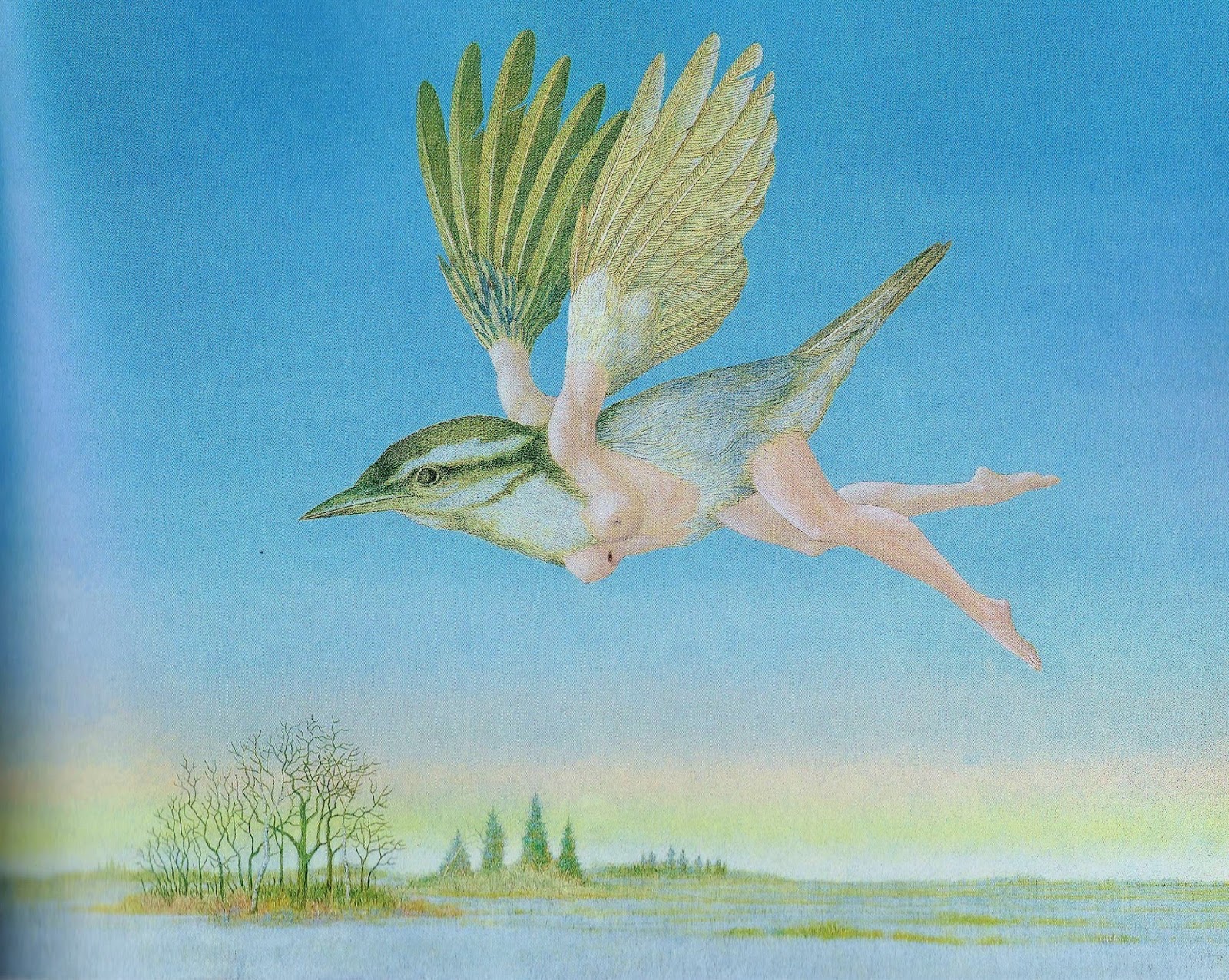 |
| "A Red-Breasted Nuthatch (Lady Bird Series)," painting by John Wilde, 1982 |
And soon Karl Wolter and Patrick Comfert began
rehabilitating wounded birds or homeless feathered friends, among other
creatures, at their Cooksville farm and aviary. Some of them, like a very tame
and friendly blue jay and large black crow, visited Cooksville folks for
handouts of peanuts and bits of meat, which they would eat or secrete in the trees
or under fallen leaves. And more recently, Karl and Patrick provided new feathered
visitors from their sanctuary-farm: peacocks and sand-hill cranes strolled elegantly
and sometimes loudly through the village.
Birds, large and small, some more easily recognized than
others, still visit the historic Village of Cooksville and the nearby farmlands, restored
prairies and the Badfish marshlands next to the little old community, where
bird-feeders are kept very busy.
* * *
[The Cooksville Archives and Collections provided the
newspaper clippings, the 1953 house-tour information, and several bird-identification
books. Larry Reed.]
Monday, January 29, 2018
2018 Cooksville Community Events
 Saturday,
April 28: Community Center Clean-Up Day (10:00am-1:00pm,Schoolhouse)
All are welcome to come out with their favorite cleaning tools to air out the
schoolhouse, sweep out overwintering beetles, and tidy up after the winter’s
window restoration project. Donuts for all participants.
Saturday,
April 28: Community Center Clean-Up Day (10:00am-1:00pm,Schoolhouse)
All are welcome to come out with their favorite cleaning tools to air out the
schoolhouse, sweep out overwintering beetles, and tidy up after the winter’s
window restoration project. Donuts for all participants.
Sunday,
April 29: Arbor Day Celebration on the Commons (1:00pm-4:00pm,
Commons, reception at schoolhouse) Hear an update from the Cooksville Tree
Committee about the state of the Oak restoration project and the health of the
area’s woods and environment. Rain or shine!

Wednesday,
May 30: Cooksville Live at the English Barn (7:00pm-9:00pm, Cooksville
Farmhouse Inn) A local talent review featuring area musicians, singers, and
performers held in the lovely English Barn behind the Farmhouse Inn. Ample parking
behind the barn. Free.
 Wednesday,
June 6: Stoughton Chamber Singers Concert (7:00pm-9:30pm,
Congregational Church) Tickets are available from McGlynn’s Pharmacy in
Stoughton, from the Singers, or at the door. $5.00 admission benefits the
singers and the CCC. A reception will follow at the schoolhouse.
Wednesday,
June 6: Stoughton Chamber Singers Concert (7:00pm-9:30pm,
Congregational Church) Tickets are available from McGlynn’s Pharmacy in
Stoughton, from the Singers, or at the door. $5.00 admission benefits the
singers and the CCC. A reception will follow at the schoolhouse.
Tuesday, June 19: Genealogy 101 (7:00pm-9:00pm, Schoolhouse) Lisa Imhoff
will help you launch your journey into family history. Nominal fee of $1 to
cover handouts. Bring a pencil with an eraser!
 Wednesday,
July 4: Independence Day Picnic
(12:30pm-2:30pm, Commons) Potluck
community meal under the Oaks. Share your favorite picnic fare and outdoor
games. Rain location is the schoolhouse.
Wednesday,
July 4: Independence Day Picnic
(12:30pm-2:30pm, Commons) Potluck
community meal under the Oaks. Share your favorite picnic fare and outdoor
games. Rain location is the schoolhouse.
Tuesday,
July 10: Wellness Series part I: Tai Chi workshop (6:30-8:30pm,
Schoolhouse)Introduction to Tai Chi: Lisa Imhoff and her friends at Lotus
Transforming Tai Chi Club will introduce you to this soft martial art of slow,
gentle movements that improves balance, flexibility and strength. Bring
comfortable shoes, water. Dress comfortably. Free admission.
Tuesday,
July 17: Wellness Series Part II: Yoga workshop (6:30-8:30pm,
Schoolhouse)Workshop for both new and experienced practitioners. Yoga
offers physical, mental, and spiritual exercise and mindfulness training. Dress
comfortably. Please bring an exercise mat if you have one, and a water bottle.
Wednesday,
July 18: Old Settler’s Stories with Ruth Ann Montgomery (7:00pm-9:00pm, Schoolhouse) A presentation on
some of the fascinating history of our area told by local Rock County
historian, Ruth Ann Montgomery. Meet and greet to follow. Free event.

Saturday,
August 11: Christmas in Summer
(1:30pm-2:30pm, Schoolhouse) Experience a one-room schoolhouse holiday pageant
as it was remembered by local residents who grew up attending small rural
schools and enjoyed performing for their classmates and families. Always fun
and full of surprises! Free event.
Monday,
September 17: CCC Annual Meeting& Ice Cream Social (6:30pm-8:30pm, Schoolhouse) All
Community Center members are invited to hear about the state of the
organization from its Board of Directors, and participate in Board elections.
The community is welcome for ice cream before the meeting. New to the Community
Center? Join us with a $25.00 lifetime membership.

Saturday,
October 20: Cooksville Halloween Party (6:30pm-9:00pm,
Schoolhouse) Old-fashioned harvest-time fun with crafts and games, a snack
and dessert potluck, hot cider, bonfire, and outdoor scavenger hunt. A good
time for all ages. Free event.
Subscribe to:
Posts (Atom)


