Showing posts with label art. Show all posts

Friday, November 25, 2022

The Historic Cooksville Trust Seeks Funds for the Cooksville Archives and Collections Project


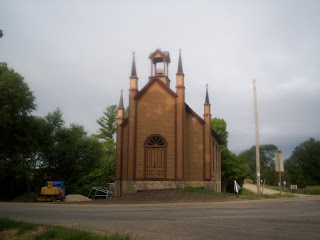
The Historic Cooksville Trust, Inc., is seeking funds to continue its “Cooksville Archives and Collections Project” in the basement “parlor” of the historic Cooksville Congregational Church (built in1879), which it now owns.

The Cooksville Congregational Church Archives/Collections Project is underway.

 The Historic Cooksville Trust (HCT), a non-profit IRS 501 (c)(3) charitable organization was established in 1999 and assists the preservation and conservation of the historical heritage of Cooksville and the surrounding Town of Porter in Rock County. Projects in the past have included the preservation of important historic buildings and sites, as well as various educational programs and the "Welcome to Historic Cooksville" highway signs.

This major Church project has begun but recent inflation has greatly increased the costs, so additional funds are needed for this undertaking, as well as for assisting other future preservation projects in the historic village. (HCT has financially assisted about 20 other projects in the past.) 

"The Little Brown Church on the Corner"

Over the years the HCT, has been donated and has collected materials and objects related to the history of Cooksville and the Town of Porter. The new Archives and Collections Center Project is an essential undertaking to preserve and maintain the collections for the future. 

The Church basement Archives/Collections plan.

Visitors, researchers, residents, and groups will be able to utilize the Archives and Collections Center in the Church basement. Of course, the existing upper nave or auditorium of the Church will continue to be available for various ceremonies, musical programs and public events.           

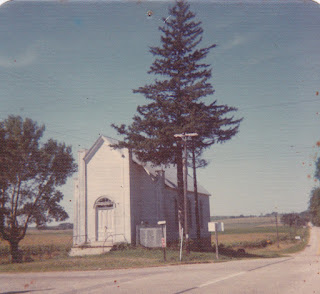
The Church as the Town Hall, c.1950s

In the past, the historic Church served the community for church services, social events, lectures, and club meetings. Then in the 1940s-1960s, the Church became the Porter Town Hall, after which it was sold in 1971, and once again began serving as a venue for weddings, ceremonies and musical performances. 

Now the renovation of the landmark Church and the use of the basement as the new Archives and Collections Center will expand its purpose in the community.   

The Village of Cooksville, established in 1842, has been recognized as a special, well-preserved historic community for the past 180 years. The Cooksville Historic District is listed in the National Register of Historic Places and the Wisconsin Register of Historic Places and is also designated a Historic Conservation District by the Town of Porter in which Cooksville is located.


Donations to fund the Church renovation project, as well as future projects, can be made to Historic Cooksville Trust, Mary Zimmerman, Treasurer, 10706 N. Tolles Rd., Evansville, WI 53536.  Questions can be addressed to Mary at (608) 628-8567 or to Larry Reed at (608) 873-5066. Donations are income tax deductible.

Thanks!

                                *   *   *                                        


Friday, November 18, 2022

Cooksville Cookbooks: Cookies Cakes, Candies, Curries and Casseroles, even a Cancer Cure

Recently, a copy of a 1941 cookbook was donated by Nancy Remley to the Village of Cooksville Archives. Titled the “Golden Anniversary Cook Book, Cooksville Lutheran Ladies Aid, 1891- 1941,” it was “dedicated to the pioneer women of this congregation” and contains about 65 pages of recipes contributed by the ladies.


The Village of Cooksville, in Rock County, Wisconsin, has been a busy community of cooks for about 180 years, appropriately enough. The Cooksville Archives collection contains a number of cookbooks from the past, including an1850s hand-written cookbook with a recipe for a “cancer ointment.”  

The old 1850s cookbook with the "cancer treatment" is a slender,18-page, hand-written cookbook that does not have a title nor an identified writer or owner. It is bound, written in ink with a neat, old-fashioned script and contains that “Receipt For making Cancer Ointment,” as well about fourteen other medicinal recipes and a similar number of cake, pudding, gingerbread, sausage, syrup, currant wine, and cordial “receipts.”

The various medicinal “receipts” are for the treatment of illnesses such as dropsy, dysentery, coughs, colds, itches, piles and tape worms, as well as cancer, with ingredients such as various roots, leaves, berries, flowers and tree barks, as well as the occasional sulfur, turpentine and pumpkin seeds.

The cancer ointment recipe is interesting because it contains tree barks (white pine, elder, elm, hemlock, red dogwood) as ingredients, two of which are now associated with the treatment of some cancers, namely, pine bark and the red dogwood (osier) species bark.  The “receipt” in the booklet for making the cancer ointment is as follows:

          “Take of red Ozier, Stinking Elder, Hemlock Boughs, White pine bark, two quarts each. Boil them together until the strength is gotten out, then strain it. Put to this Mutton tallow, honey, bees-wax, the marrow of a hog’s jaw and fresh Butter of each the size of a hen’s egg. Simmer it moderately over a slow fire until it becomes an ointment.”

The cake recipes also in this old cookbook include a Mrs. Pecks Cake (perhaps this is from Rosaline Peck, Madison’s first innkeeper in the late 1830s), a Tea Cake, Temperance Cake, Cider Cake, Caroline Cake, and a couple of nut cakes and a Rice Plumb (sic) Pudding.  Some measurements are in “gills” and some require butter the size of a walnut, a hen’s egg or a goose egg. 

Another nineteenth-century cookbook found in the village—actually a famous nationally published cookbook titled “Mrs. Lincoln’s Boston Cook Book,” by Mrs. D.A. Lincoln, 1889— was originally owned by Mrs. J. W. Sales, probably of Janesville. She apparently passed it on to Cora Atwood of Cooksville. The last ten unprinted pages of the published book have been filled with more than 50 hand-written recipes of various kinds from friends (one is dated 1915), including a recipe for “Scotch Woodcock” (chopped hard-boiled eggs in cream sauce on toast).


Two World War II era commercial recipe booklets are also in the archives. One entitled, “A Guide To Wartime Cooking” (1943) has 46 pages and was published by the H.J. Heinz Company of Pittsburg and includes a “Nine Point Plan for Wartime Eating.” It addresses the need for “managing the food supply: shopping under the point ration program… packing a lunch pail that will keep your man strong and healthy, wide awake on the job.”


Another WW II booklet (undated) with 26 pages is titled, “Wartime Recipes From Canned Foods” and was published by the American Can Company, New York. It states: “It is imperative that we plan our menus carefully and use our ration points for the canned foods which help to make the family meals adequate from the standpoint of good nutrition” and to “show you many different ways of making a can of food serve more People.”

A 1951 "Cook Book: Favorite Recipes” was compiled and printed by the Cooksville Mother’s Club and contains 78 pages including a section on helpful hints that “may be there to help you when your husband’s help won’t do.” Lillian Porter’s preface, titled “Cooksville: Community of Culinary Culture,” describes the history of the Village of Cooksville and its creative cookery as a “pleasant mixture of nationalities, creeds and customs,” including a brief history of Cooksville, its early settlers and the women who were “expert wielders of the egg beater and rolling pin.” One intriguing “Sandwich Hint” is an “Orange - Cream Cheese - Peanut Butter” spread containing those three ingredients. The Club was associated with and provided support to the Cooksville School with various fund-raising efforts.

In 1981, the Cooksville Lutheran Church published a 104-page cookbook of its “Lutheran Favorites” and titled it “Our Daily Bread," with recipes of cakes, cookies and other sweets and a number of favorite soups, salads and “main dishes."

Another addition to the collection is a more recent “Cooksville Lutheran Church Cookbook,” dated 2006 and re-printed in 2016. The cook book, below, contains about 362 pages of recipes including a section titled, “Canning & Freezing, Norwegian, Nationality & This and That” and shares recipes for Lefse and Tres Leches Cake, among others.

These old cookbooks reveal the tastes of the times and the foods prepared, preserved and eaten— with many desserts to be devoured. They are illuminating and sometimes tempting records of the nourishing breakfasts, lunches and dinners through more than 180 years of cooking in and near the little—and always hungry and well-fed— Village of Cooksville.

Perhaps there are other personal village cookbooks with Cooksville family recipes (or “receipts”), sitting on back shelves or stored in attic boxes, waiting to see the light of somebody’s kitchen and to help fill the cookie jars.

                          *  *  *                             

                      Larry Reed


Saturday, August 13, 2022

EARLY HAPPENINGS IN HISTORIC COOKSVILLE

In the 19th and 20th centuries, the little Village of Cooksville, founded in 1842 on an endless prairie with oak-opening in southern Wisconsin, received a good amount of attention. Facts of life in that early Village are contained in the first settlers’ letters, diaries and scrapbook, as well as in the first area newspapers and publications and in the research and writings of Cooksville’s historians.

These bits and pieces—mostly facts, some gossip— give glimpses of life including its fancy new wooden sidewalks and the frequent fresh oyster which were suppers supplied in salt-water-filled wooden barrels from distant Milwaukee or Chicago.  Here are a few glimpses:

 Vote at first town meeting, April 6, 1847: “ For Equal Sufferage (sic) – Twenty-Eight.  Against Equal Sufferage (sic) – Thirty Four.”

“The first church at Cooksville was organized in 1842, a Free Will Baptist church with 12 or 16 members, who held their meeting in Mr. Cook’s log house. Their pastor was Elder Low who preached without a salary. He had a small farm where he made a living like the other settlers. The first yearly meeting was held in a saw-mill that Mr. Cook had erected and was largely attended.”

“Up to 1848, the principal centers of business for the whole country between Janesville and Madison were at the village of Union or Cooksville, on the Badfish creek…”

Town of Porter Meeting, April 1, 1856: “A Resolution was presented to the Electors to prevent pigs from running at large upon the Highways under a penalty of  Five Dollars was postponed…until the next annual meeting.” April 7, 1857: “Resolved that all Sheep and Swine in the Town of Porter be restrained from going at large on the Highways under the penalty of fifty cts for each head found running at large.”

 “Post office established in Cooksville in 1849, mail brought horseback from Union…”  “Official letter, dated 24 Dec 1864, designating Cooksville Post office 5th class, setting the salary of the Postmaster at $37 annually…”


Cooksville General Store c.1930s

Masonic Lodge. Jan. 20, 1859:  “Trustees leased the second story of the store now owned by Abigail Woodbury to be used for a Masonic Hall at $50 for the first year, $45 for the next three, lease to run for four years …” “Specifications for hall drawn up in 1864; contract provided for completion by August 1, 1864…” Dec.16, 1864: “:…master and wardens bought store….” Dec. 1879: “…a few days papering and otherwise repairing the Masonic Hall…with new chandeliers, new carpets…this is now a very attractive room.”  Sept 1882: “The Masonic Lodge are improving their building by a new front to the store.”

 Dec. 17, 1873: “Stage to Stoughton via Union, Cooksville, &c will leave here (Evansville) at 7:45 a.m. instead of nine o’clock, as heretofore, and return about 8 o’clock same evening, Tuesdays, Thursday and Saturdays.”


Arrow-heads found in Rock County

1875. “Mr. Hoxie found, a few days since, an unfinished arrow, a spear head, convex on one side, slightly concave on the other, which measures five inches long and two and one-fourth wide. This is one of the largest of this kind of Indian relics ever found in that vicinity.” 

Cooksville Congregational Church (1879) with horse/carriage shelter at rear

Jan.1879: “Understand that our friends at Cooksville are about to perfect an organization that foreshadows the building of a church this season.” Feb. i879: “The people of Cooksville have finally located their church on the corner as you pass by the Union road. The location affords good ground for a basement, which they purpose to construct in connection with their church properly.  Dec. 18, 1879: The great event for the last week was the dedication of the new church, and it was a good omen to see Methodist, Baptist, Congregationalist, Universalist and Unitarian all on one platform… The basement of the church will now be finished as soon as possible, with assembly room for Lodge meetings, sociables, lectures, &c., &c., and at one end a furnace room, kitchen, closets and stairway...”

1875. “The terrible mud has started a subscription paper to raise funds to build sidewalks and enough has been pledged to lay them on streets where most needed… So, hurrah for the sidewalks.” April 1875: “The sidewalks are laid down, or at least enough so that one can get to the post office without getting lost in the mud…”  3 May 1878: “ This town is putting on some style with side walks, and now a street lamp at the crossing in front of Mr. Robertson’s store. “

Dec. 5, 1879: ”This ‘burg’ is putting on metropolitan airs with four street lamps. Mr. James Fairgrieves, our tinner, has displayed both taste and skill, besides a generous gift of a fine street lamp, and the same has been put in position at the corner of the church by B.S. Hoxie.”

July 28, 1880: “Cooksville Gossip: Sunday while Mrs. Aris of Janesville was walking down town she fell through one of our trap sidewalks and received some slight injuries,”

1879.  “A visit to the mill formerly owned by N. Davenport but now by W. Leedle & Son, shows it is much improved.” April`1881: “About a dozen boys had some rare sport one day last week. As the gates of the upper mill were shut down to make some repairs, they discovered fish by the hundreds and spears, pitch-forks and the hands scooped them out. So for once about every family in town had fresh fish for breakfast.”

“Evansville Review Feb. 22, 1882. [T]he current tobacco boom… In 1881, 12,000 acres of tobacco in Wisconsin; Dane County 4,8674 acres; Rock County 5,704 acres. Banner town in state Christiana, Dane County, with 1,125 acres; second is Porter, Rock County, with 1,118 acres. “


Tobacco barn, now demolished

1883: (Christopher) Preston & (John) Searles, broom and brush manufacturers of Cooksville, are turning out good work and will sell at wholesale as cheap as any house  this side of Chicago…making six dozen brooms a day” “…1887: “ In the old Hoxie shop:…received a large shipment of broom corn Tuesday, with a large demand for their make of brooms..”  1890: “Mr. Jack Robertson (blacksmith) now occupies the shop…formerly used as a broom factory.”


Robertson Blacksmith Shop


1883. Cooksville: “This is indeed a land of artists. Most every other one you meet has brushes and a palate or an easel under his arms.”

Enterprise Newspaper. From Cooksville, Feb. 4th, 1885: “Our library prospects are so flattering that I cannot resist the desire to inform your readers of its future outlook. A few of us banded together last December and incorporated a ‘Public Library Association of Cooksville’ and since January first we have accumulated upwards of $40 and no skating rink about it either. We hold sociables every two weeks, Last night we had a box sociable where the ladies brought nicely decorated boxes and the gents bid them off at various prices. The boxes brought by Mss. Belle Rice and Miss Mable Woodbury sold each for $1.25….Next week, the Editor willing, I will give the list of books just received.”


Belle Rice in her parlor

Enterprise Newspaper. Dec. 15, 1885: “Social Life. The Cooksville people seem to enjoy themselves about the best of any community we know of…they have had some delightful gatherings where all joined together as one family without any jealousies or hard feelings, and no scandals or brawls have their starting place there. As a progressive, literary, talented people we think they are above the average.” 

Enterprise Newspaper, Dec. 22, 1885: “The ‘Jolly Club,’ of Cooksville, will give a rousing New Year’s Party at the Masonic Hall in that place on New Year’s Eve.” Jan. 1886:“The Jolly Club dance was an entire success, about thirty couples in attendance…Arrangements are in progress for the laying of a new canvass (on the wood floor) so the ladies can wear their Cinderella slippers.”


Electa Savage with Paul and Avis c.1880

Enterprise Newspaper. Feb.6, 1889: “We understand that Mrs. J.E. Savage is having her ice house ready for the summer campaign. We can almost taste her cool and refreshing icings as we write.”


Cooksville's Public Square, created in 1846

July 20, 1889: “Cooksville: The workmen have begun working on the race track around d the park (Pubic Square)  which will be ready to drive on in a few days…. June races will take place on this track in the future…” Sept. 4, 1889: “The race track is nearly ready for use. There will be a base ball ground laid out and all league clubs including Evansville and Chicago will be invited to play on this ground.”  Oct. 12, 1889: “Our Race Track is now in good condition for driving. Driving tickets can be purchased at the Post Office or the Broom Factory.”

Wisconsin Tobacco Reporter.  6 Nov.1891: “E.M. Stebbins has been appointed postmaster at Cooksville in place of C.H. Woodbury, resigned. Mr. S. (Stebbins) is the successor of Woodbury in the store at that village.”

Tobacco Reporter.  9 Oct.1903:” The Cooksville post office has been discontinued and all mail formerly addressed to that office should be addressed to Evansville RFD.”

Wisconsin Tobacco Reporter, 22 June 1894: “Cooksville:  Mr. Forest’s family arrived from Chicago Tuesday and is living in what is known as the Collins House. Mr. Forest has the frame up for his new blacksmith shop... That makes five blacksmith shops in town: Graves, Berry, Courter, Hanson and Forest.”


Graves Blacksmith Shop, restored
Dec, 8, 1894. Cooksville: “Carpenters are at work on the 24 ft addition to the store. The Masonic Hall will be enlarged and the room over the new part will be used as a dining hall.”


Good Templars at work (but not Cooksvillians)

1895. “Good Templar members… at a meeting on January 12, 1895… 8 gallons of oysters were disposed of and a barrel of crackers was cleared.”


Ralph Warner at his "House Next Door" in Cooksville c1920

1912.  Cooksville..:“Mr. Ralph Warner is settled in his new house  (Duncan House) which he purchased principally because the old-fashioned fireplace appealed to his love of old things….It is finished up in an old style… He loves everything that is old and is pleased to show his curios to interested friends. We will tell more of him later on.”

     [From items in the Cooksville Archives and Collections. Larry Reed]

                                                 *  *  *      


Saturday, May 13, 2017

Cooksville Celebrates Arbor Day


More than 36 Cooksville area residents gathered together on April 30 at the Cooksville Community Center to celebratte the addition of three new trees on the Commons, to view eductional posters on arbor culture, and to discuss the plans the Cooksville Commons Conservation Committee has for this treasured space in 2017 and the future.
In his opening remarks for Cooksville's second Arbor Day celebration, Karl Wolter of Cooksville said it best:  "Today is the kind of day a tree loves -- cold, wet and cloudy."

Fosdal's Bakery created an oak leaf cake.
Village residents Meri Lau and Mark Verstegan created commemorative plaques for attendees to finish individually featuring a scene of the Cooksville Community Center (formerly schoolhouse) and the burr oaks.  White pine saplings were available to take home and plant, in keeping with the vision of Arbor Day founder J. Sterling Morton.
Emma Mallon and Meri Lau enjoying the festivities.

The Cooksville Commons Conservation Committee was formed in 2016 as we began plans for celebrating 175 years as a community.  The group has received a matched funds grant through the Wisconsin DNR Urban Forestry Program to help with a tree inventory and management plan for the wood lot on the Commons, as well as tree planting.  For questions about the committee, additional activities planned for the year, joining the group, volunteer opportunities and donations, contact Karl Wolter (873-6998, Mary Kohlman (882-5559) or Meri Lau, email  Meri_Lau@yahoo.com

Tuesday, October 27, 2015

Cooksville’s Artists and Artisans, Part Four: Dorothy Hansen Kramer Toigo, by Larry Reed


Over the 175 years of its existence, the Village of Cooksville, like every community, had its share of talented artisans, maybe more than most small villages that never had more than 175 residents. Perhaps Cooksville’s “smallness” combined with its special “architectural quaintness” helped attract and create a community supportive of artists, artisans and antiquarians. Its well-cared-for character certainly impressed Wisconsin’s premier architectural historian Richard Perrin to propose in1962 that historic Cooksville would make an excellent place for an “old world Wisconsin” outdoor architectural museum.
Dorothy Kramer (1900-1971)
One of the village’s 20th-century artists was Dorothy Hansen Kramer Toigo (Sept 21, 1900-Oct. 30, 1971). She was an art and crafts teacher and a life-long practicing artist.  Employed in the WPA arts program in Illinois in the mid-1930s, she also was an art teacher at Ferry Hall, Lake Forest, Illinois, in 1958-59, and at Stoughton, Wisconsin, in 1959-60, and then once again at Ferry Hall from 1960-69. She lived about 45 years in Cooksville, always pursing her various artistic endeavors.

Dorothy specialized in ceramics and weaving. She studied at the School of the Art Institute of Chicago from 1921 to 1924 where she met and soon married Arthur Kramer (1892-1962), an advertising and business teacher. (They also met Elton Breckenridge there who eventually taught at Chicago’s Art Institute and eventually purchased his home in Cooksville in 1952, where he continued his close friendship with the Kramers, helping to decorate some of Dorothy’s pottery; in 1976 “Breck” left the village and his home, “Breckhurst,” with its brick terraces, fountain and statuary  he had created.)

At first, Dorothy Kramer lived part-time in Cooksville in the historic Benjamin Hoxie House, which her father bought for her in 1926; he then also bought the Robertson Blacksmith Shop property next door for her in 1930. She lived there permanently beginning about that year and with her husband Arthur operated a very active pottery studio there from 1952-56.
Dorothy Kramer pottery

In 1953, the Cooksville School’s student journal-newsletter reported that “Arthur Kramer has an interesting hobby of making pottery. He uses some Cooksville clay, taken from the bottom of the Badfish creek. The clay is shaped by turning it on a potter’s wheel. It is fired and glazed in an electric kiln at a temperature of about 1923 degrees F. When the clay is fired, it is a deep buff, but when it is freshly dug, it is gray. Some of the things he makes are pottery mugs, vases, ash trays, bowls, and jam jars.”  Arthur had been commuting to Cooksville from Chicago, where he worked during the week, but spent his weekends setting up his and Dorothy’s artist work spaces.
Apparently, Arthur made his pottery in the Blacksmith Shop-studio, with Dorothy doing the decorating and glazing. But soon, according to a family report, “they couldn’t work together so she started doing it herself. Plates, bowls, cups.”  Arthur also built looms for his creatively active wife who began weaving various items (place mats, napkins). She probably taught her nearby neighbor Marvin to hook rag rugs.

Map of Cooksville by D. Kramer 1955
Together, Dorothy and Marvin Raney operated the “Cooksville House” where they sold their arts and crafts in the mid-1950s, along with weavings and blacksmith-forged and silver items by others. (Marvin was an antique collector and dealer in Cooksville as well as a weaver and owned the Duncan House and “Waucoma Lodge.”). The Cooksville House shop was first located in the old Duncan House barn and then in the Backenstoe-Howard House (“Waucoma Lodge”) in the late-1950s. A note came with each purchased piece stating, “Your gift from Old Cooksville in Wisconsin is a genuine hand-crafted work, created with the same high regard for honest craftsmanship that has distinguished our arts for more than a hundred years…. It comes to you with some of the craftsman’s heart in it, and a little bit of the beauty of the old village.”

Dorothy’s artful pottery had a distinctive style, based on her admiration of the forms and colors of ceramic pottery from thirteenth century Korea. Her green glaze apparently was based on this early Korean pottery, a piece of which was gifted to her by a nephew. Her pottery pieces in that distinguishing style are highly valued. She also produced small, simple pottery pieces that were sold to visitors to old Cooksville—tea cups, coffee cups, saucers, jam pots, ashtrays, decorative square ceramic tiles, many with her charming, simple, hand-painted portraits of Cooksville’s buildings. She also painted at least two primitive maps of Cooksville-Waucoma in 1938 and 1955, which are valuable documents of the co-joined villages.

Hoxie House tile painted by D. Kramer
In 1970 after Art Kramer died, Dorothy married John Toigo in Cooksville. She had met Toigo earlier in Chicago in the 1920s, and they lived briefly in New York City in 1970, returning to Cooksville in 1971, where she died of cancer. She is buried in the Cooksville Cemetery.

Dorothy’s sister, Helen Rose Hansen Naysmith Toigo Bradley (1906–1989), also lived in Cooksville beginning in the 1930s in the Morgan House, first as a summer home, then after 1945 permanently, when she taught in several area schools. Many happy Hansen family reunions took place in Dorothy’s and Helen’s backyards of their historic Cooksville houses. Helen’s son Jim Naysmith now lives in the Morgan House.

[Material for this story came from the Cooksville Archives and from “The History of the Hansens & Salisburys in Europe and America 1020-2010 and beyond,” by Mary E. Osgood and Charles F. Osgood, 2014.]
(COOKSVILLE’S ARTISTS AND ARTISANS: to be continued.)

Monday, June 29, 2015

John Wilde’s Art Featured at Museum of Wisconsin Art in West Bend, by Steve Ehle


Shirley and John Wilde shown in 2006 at the Cooksville Commons. (Photo by Steve Ehle)
  
John Wilde was a good neighbor and fine friend to many in the Cooksville area, as well as in Evansville.  Those who knew him no doubt saw a quiet, unassuming man with a gentle wit and an appreciation for all things natural and beautiful.
            But those who may have known him better, those who knew his past accomplishments as a respected professor at UW-Madison and as an internationally known artist who was a part of the so-called “magic realist” movement in art circles, would understand why one of Wisconsin’s foremost museum galleries is now featuring many of his finest and least seen artwork.
            From June 13 to September 6, the Museum of Wisconsin Art (MOWA) in West Bend is devoting considerable space and time to a special Wilde exhibit. “Wilde’s Wildes: A Very Private Collection” includes approximately 80 paintings and drawings, most of which had hung or had been stored in John and Shirley Wilde’s Cooksville area home.
           

The cover of the catalog published for the "Wilde's Wildes" exhibit show available for viewing at the
 Museum of Wisconsin Art.
The exhibit includes some of John’s early works as a student at UW-Madison and follows his personal art history to just a couple years before his death. Many of the sketches and paintings depict John himself, as well as Shirley. And, of course, there are framed pieces of their beloved Corgies – Banjo, Bugs, Beans and Bryn.
            John died in 2006. Shirley, his wife of 46 years, died earlier this year. Since Shirley’s death, their respective children gathered most of the artwork that their parents retained in their home for themselves and provided the collection to the MOWA for this unique exhibit.
            John and his first wife, Helen, lived in Evansville from the early 1950s to the mid-sixties. Helen died in 1966. John and Shirley married in 1969 and lived in their Cooksville area home until their deaths. John, Helen and Shirley are buried next to each other in the Cooksville Cemetery. Between them, they had five children.  Both John and Shirley served on the Board of the Historic Cooksville Trust, Inc. until their deaths.
             In the foreword to a 66-page full-color exhibit catalogue compiled and written by exhibit curator Graeme Reid, MOWA’s Executive Director/CEO, Laurie Winters writes:
            Wildes’s Wildes: A Very Private Collection celebrates the private collection of John Wilde (1919-2006), one of the leading artists of the American Surrealism movement. Over seven decades, Wilde created a collection of the own paintings and drawings, works that easily could have found homes in museums or private collections but that he retained instead for his own enjoyment. Wilde’s Wildes recreates the artist’s collection, which includes paintings and drawings from every decade and phase of his long career as well as some of his earliest works in the late 1930s.”
            At the June 18 exhibit opening, curator Reid took attendees through the second floor gallery devoted to John’s works and explained how the exhibit was compiled and provided an anecdotal narrative to John’s life and work. Later, Reid made a formal expanded presentation for those gathered for the opening. Reid has been invited to repeat his Wilde slide presentation program at a venue in Evansville. An announcement will be made later this summer regarding time and place for this event.
            For more information on the Wilde exhibit at MOWA, visit the museum’s website at www.wisconsinart.org. The Wilde’s Wildes: A Very Private Collection catalogue is available for purchase from the MOWA Shop at a cost of $58 and can be ordered online, or it can be downloaded free of charge from MOWA’s website.
           
A John Wilde painting of Steve Ehle and his dog Davey painted in 2004.
Six of John’s works are on permanent display at UW-Madison’s Chazen Museum, and his painting “15 Cooksvillians” (1996) has been donated to the Chasen. His large 1997 hand-colored print “15 Cooksvillians” hangs in many Cooksville area homes, as do John’s portraits of local friends Steve Ehle, Michael Saternus, and Bill and Joyce Wartmann.